
Uncategorised
- Details
- Written by Super User
- Category: Uncategorised
- Hits: 5
Accomplishment Report
{tab title="2025" class="orange"}
{tab title="2024" class="blue"}
| 2024 GAD Accomplishment Report |
{tab title="2023" class="green"}
{/tabs}
- Details
- Written by Super User
- Category: Uncategorised
- Hits: 5
Gender and Development Checklist
- Details
- Written by Super User
- Category: Uncategorised
- Hits: 5
Harmonized Gender and Development Guidelines
{tabs title="Harmonized GAD Guidelines" class="blue"}
| 2021 |
| 2020 |
| 2019 |
{/tabs}
- Details
- Written by Super User
- Category: Uncategorised
- Hits: 4
GAD Constitutional Issuances
{tab title="Constitutional Issuances" class="green"}
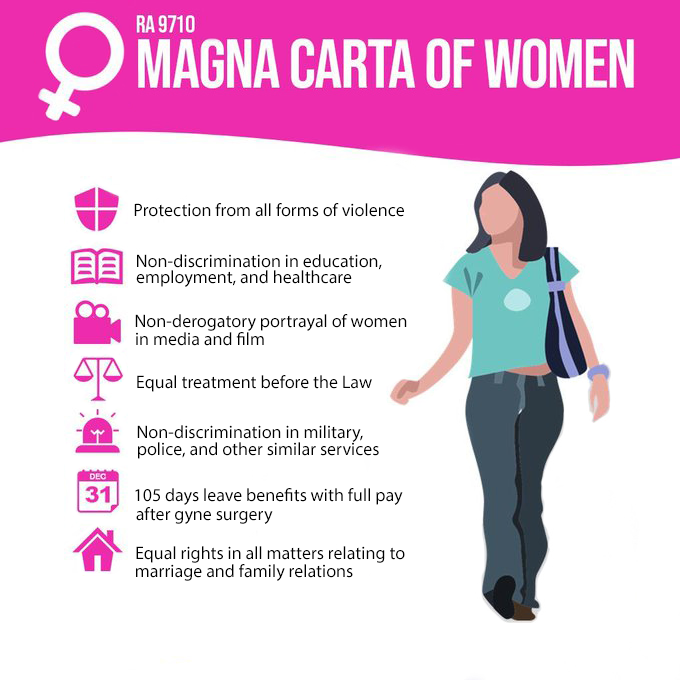 |
R.A. 9710: Magna Carta of Women It is the local translation of the provisions of the Convention on the Elimination of All Forms of Discrimination against Women’s (CEDAW), particularly in defining gender discrimination, state obligations, substantive equality, and temporary special measures. It also recognizes human rights guaranteed by the International Covenant on Economic, Social, and Cultural Rights (ICESCR). |
{slider title="R.A. 8353: Anti-Rape Law of 1997" class="orange"}
 |
R.A. 8353: Anti-Rape Law of 1997 Rape is an inherently violent crime that typically results in physical, social, emotional, and psychological harm. It remains a prevalent social problem in the Philippines, and throughout the world. Republic Act (R.A.) No. 8353, otherwise known as the Anti-Rape Law of 1997, expanded the definition of the crime of rape in the Revised Penal Code (RPC) and re classified it as a crime against persons instead of as a crime against chastity. As a crime against persons, the law no longer considers rape as a private crime. Thus, anyone who knows of the crime may file a case on the victim's behalf, and prosecution may continue even if the victim drops the case. |
{slider title="R.A. 7877: Anti-Sexual Harassment Act of 1995" class="orange"}
 |
R.A. 7877: Anti-Sexual Harassment Act of 1995 Work, education or training-related sexual harassment is committed by an employer, employee, manager, supervisor, agent of the employer, teacher, instructor, professor, coach, trainor, or any other person who, having authority, influence or moral ascendancy over another in a work or training or education environment, demands, requests or otherwise requires any sexual favor from the other, regardless of whether the demand, request or requirement for submission is accepted by the object of said Act. R.A. 7877 - Anti-Sexual Harassment Act of 1995 |
{slider title="R.A. 9262: Anti-Violence Against Wommen and their Children Act of 2004" class="orange"}
 |
R.A. 9262: Anti-Violence Against Women and their Children Act of 2004 R.A. 9262 - Anti-Violence Against Women and their Children Act of 2004 |
{slider title="R.A. 8972: Solo Parents Welfare Act of 2000" class="orange"}
 |
R.A. 8972: Solo Parents Welfare Act of 2000 An Act of providing for benefits and privileges to Solo Parents and their children, appropriating funds therefore and for other purpose. R.A. 8972 - Solo Parents Welfare Act of 2000 |
{slider title="R.A. 11210: 105-Day Expanded Maternity Leave Law" class="orange"}
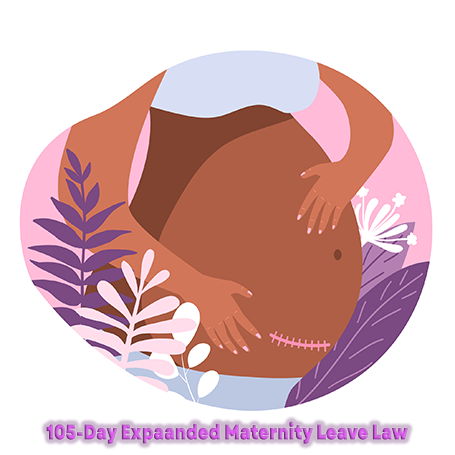 |
R.A. 11210: 105-Day Expanded Maternity Leave Law The 105-Day Expanded Maternity Leave Law provides the updated policy on maternity leave that covers females who are workers in the private and public sectors, workers in the informal economy, voluntary contributors to the Social Security System (SSS), and national athletes. It likewise grants a woman the option to allocate up to seven days of paid maternity leave to her child’s father or an alternate caregiver. The 105-Day Expanded Maternity Leave Law provides the updated policy on maternity leave that covers females who are workers in the private and public sectors, workers in the informal economy, voluntary contributors to the Social Security System (SSS), and national athletes. It likewise grants a woman the option to allocate up to seven days of paid maternity leave to her child’s father or an alternate caregiver. R.A. 11210 - 105-Day Expanded Maternity Leave Law |
{slider title="R.A. 9775: Anti-Child Pornography Act of 2000" class="orange"}
 |
R.A. 9775: Anti-Child Pornography Act of 2000 Refers to a person below eighteen (18) years of age or over, but is unable to fully take care of himself/herself from abuse, neglect, cruelty, exploitation or discrimination because of a physical or mental disability or condition. R.A. 9775 - Anti-Child Pornography Act of 2000 |
{slider title="R.A. 8505: Rape Victim Assistance and Protection Act of 1998" class="orange"}
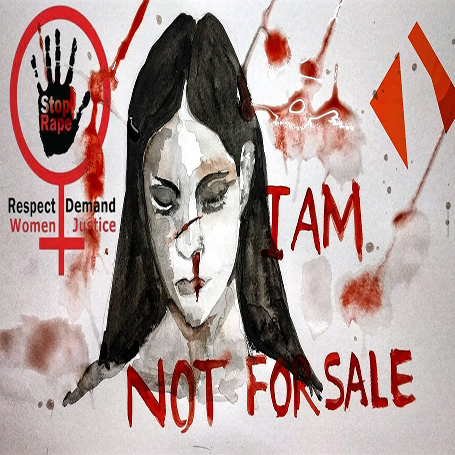 |
R.A. 8505: Rape Victim Assistance and Protection Act of 1998 otherwise known as “An Act Providing Assistance and Protection for Rape Victims, Establishing for the Purpose a Rape Crisis Center in Every Province and City, Authorizing the Appropriation of Funds therefore and for other purposes” was enacted on February 13, 1998. R.A. 8505 - Rape Victim Assistance and Protection Act of 1998 |
{slider title="R.A. 71925: Women in Development and Nation Building Act of 1992" class="orange"}
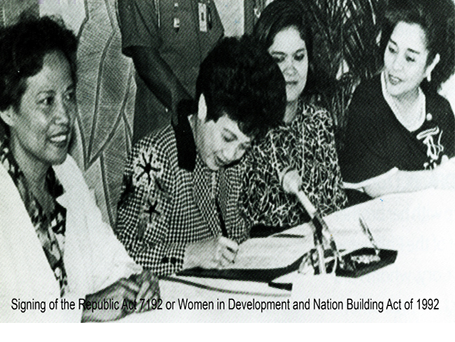 |
R.A. 7192: Women in Development and Nation Building Act of 1992 The State recognizes the role of women in nation building and shall ensure the fundamental equality before the law of women and men. The State shall provided women rights and opportunities equal to that of men. R.A. 7192 - Women in Development and Nation Building Act of 1992 |
{slider title="R.A. 10354: Responsible Parenthood and Reproductive Health Act of 2012" class="orange"}
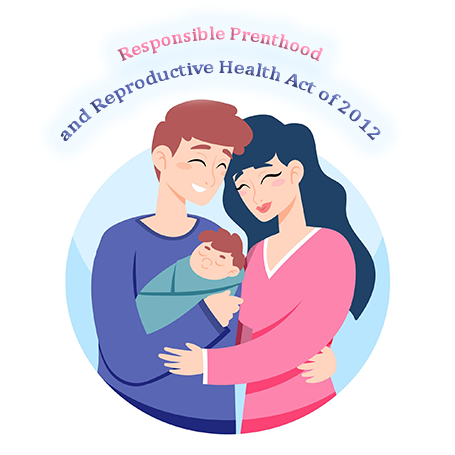 |
R.A. 10354: Responsible Parenthood and Reproductive Health Act of 2012 The State recognizes and guarantees the human rights of all persons including their right to equality and nondiscrimination of these rights, the right to sustainable human development, the right to health which includes reproductive health, the right to education and information, and the right to choose and make decisions for themselves in accordance with their religious convictions, ethics, cultural beliefs, and the demands of responsible parenthood. R.A. 10354 - Responsible Parenthood and Reproductive Health Act of 2012 |
{/sliders}
{/tabs}